

https://tumekestudio.com/indigenous-futurism-designing-a-world-to-evoke-experience/
The world of Errata is not meant to be easy. It is not clean. It is not a utopia. It is a world shaped by collapse: the collapse of environmental balance, cultural cohesion, and the value of human life. And that collapse was not a natural disaster. It was engineered by a system that elevated extraction over relationship, control over care.
In many ways, Errata reflects the world we live in now: where corporate plutocracy masquerades as representative government, where political influence is bought and sold without even the pretense of public good. This system does not fail by accident; it succeeds by design, concentrating wealth and power while dissolving the structures that once held communities together.
In response, we do not build Errata as escapism. We build it deliberately, through a Māori-led kaupapa. That means the world does not just include Māori values as decoration—it is structured by them and uses these values to encourage the player to ask what matters to them. Will the player choose control and pursuit of profit, or choose relationship and humility? Neither is painted as intrinsically good or evil, instead both systems have an innate cost to them that must be navigated to succeed in either one. Where collapse is framed as inevitable, we offer survival that is cultural, strategic, and ancestral. Not ornamental. Foundational.
We draw from whakapapa, manaakitanga, kaitiakitanga, tapu/noa, tikanga, and utu. Each is embedded into how cultures are written, how systems respond, and how the player learns to navigate difference. These are not thematic values. They are gameplay logic. By exploring these Māori values we also explore their opposites through the lens of corporatism, self-interest, and power.
A World Where Care Must Be Chosen
In Errata, the Clone Kings haven't inherited power. They rule because the systems they built still haunt the present: manipulated archives, broken bureaucracies, and genetic tinkering have all been used to extract personal benefit. If their dominance is contested then dissent is quickly silenced, whether inside or outside of their city boundaries.
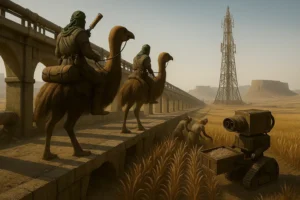
Cultures within Errata respond to this pressure differently.
- Highlanders operate through systems that bind behavior to environment through rituals, naming practices, and territorial codes. Power is expressed through inherited location, precise control of protocol, and constrained flexibility in public life. In some ways they are like the Dryrunners, with longstanding tradition and form underpinning identity and providing cultural cohesion. In other ways they are like the Plateau societies, being ruled by Clone Kings intent on continuing industrial practices focused on efficiency and output.
- Dryrunners exist on the fringes, moving across the land and using what they need, but never establishing long-term residence. This allows them to bypass Clone King authority and maintain their own cultural integrity, and their journeys expose them to resources stationary societies have grudgingly come to depend on, though none will say so outright. Their rejection of Clone King authority has branded them a threat, but the further outside the cities a person travels, the less the Clone King decrees matter.
- Drifters emerge from rupture—unhoused, unanchored, or disavowed by origin. Some build new trust systems through trade or collective knowledge. Others operate in isolation, following rules of their own making. No single structure defines them, but their behavior is shaped by distance, not allegiance. Unaffiliated, they have a rare freedom of choice.
The Plateau cities often talk about care, but the systems underneath still reward obedience, compliance, and control. Even when a player is helped by a benefactor or given access to resources, that support often carries invisible cost. Debt is rarely named, but always implied.
Other factions and cultures exist. Groups like the Faceless roam the deserts, trading human life like chattel property. And rumors persist of people and places outside of Clone King reach. Whether these are just rumors or have basis in fact nobody knows. Those who have gone out to validate them do not return.
Players aren’t handed a morality system. They’re handed a world that reacts. Communities remember how you behave. Trust builds slowly and can be lost quickly. You learn not through cutscenes, but through consequences.
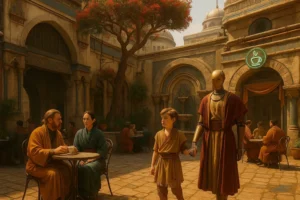
Automata: Memory, Care, and Contract
Automata in Errata are not sentimental machines or genre tropes. They are legacy systems—built to serve, owned by contract, and designed to follow logic before loyalty.
Every automaton operates from its original purpose. A combat unit holds to strict protocol. A Liaison is more adaptive, but no less bound by its operating logic. Even when they seem emotional or expressive, those responses are simulated. Their actions follow internal contracts the player cannot always see.
You can’t control them directly. Some may travel with you, others may resist, but all act in relation to what they were built to do. And yet, even the most rigid system responds to care. Automata are not just tools. They are part of the ecosystem—repositories of memory, record, and utility. Automata have been known to reveal one or two their secrets from time to time.
Visual Logic: Spirals, Grids, and Boundaries
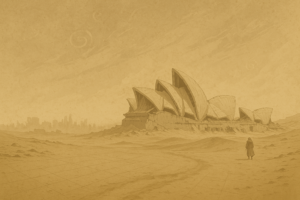
The look of Errata follows the same internal logic. Every image holds tension—between spiral and grid, between memory and control.
You’ll see whorled shapes—swirls, curves, layered forms—pulled from natural pattern and Māori visual tradition. Forms like the koru hold meanings: continuity, regeneration, time that moves in cycles. We place those forms deliberately against flat planes, clean grids, and rectilinear divisions. That contrast is not stylistic. It’s structural.
The grid represents control. Division. Mechanization. It is the language of industry, surveillance, and precision. The spiral pushes back—offering care, complexity, and non-linear inheritance.
Even the site design reflects this tension. Not everything is explained. Some things are shown without context. That’s deliberate. This world is presented as taonga: not a product for consumption, but a space to engage with on its own terms.
Conclusion
Errata is not a world to conquer. It is a world to navigate.
Players are not cast as saviors. They’re participants that thread their way through systems that remember, punish, adapt, and sometimes reward. Success isn’t measured by restoration or dominance. It’s measured by who you choose to stand with, what you choose to carry, and how you respond when the system pushes back.
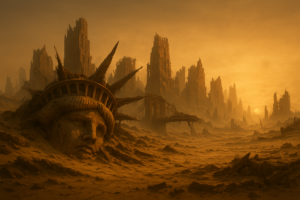
We didn’t build a morality engine. We built a world with pressure. One where care, exploitation, loyalty, and refusal are all viable—but none are clean. The work of survival in Errata is relational and purpose driven.
This is not a story about restoring balance. It’s a system that asks:
When the old world won’t return—what kind of world will you make instead?
Edward Stanaway
Founder and Creative Director
Tumeke Innovation Ltd