
Introduction
The Dryrunners are not wanderers by misfortune, but inheritors of the Great Dust Basin, a scorched expanse where only constant movement ensures survival. Their Wahka caravans drift endlessly across alkali plains and choking clouds of silt and dust. They exist in delicate balance with their surroundings, the Basin providing both shelter from the prying eyes of Clone King delegates and being host to hidden dangers unique to the area.
The Basin appears a wasteland to outsiders, but for Dryrunners, it is home. Their language and relationship with the world have created metaphor based on their movement through it, adapting from old Earth into new forms, while still remaining close to Te Reo, their ancient spoken word. Now called Haerekorera (The Now Speech), it celebrates movement as part of heritage.

Though the oceans have vanished, Dryrunners still sail. The Dust is their sea now—mercurial and unforgiving. Dunes replace waves, silt replaces surf, and ancient dead waters simmer beneath layers of alkali, thick with salt and the poisons accumulated from an industrial age long since gone. The Dryrunners read the dust, their Hakū traveling in disciplined unison.
In this domain, Dryrunners hold no nostalgia for water. Instead, they uphold stories passed down as maps of endurance. Each Wahka bears purpose. Whether for habitation, ceremony, extraction, or protection, it is treated as whanaunga, or kin. Their convoys, commonly Runs, but internally known as Hakū are bound not by blood but by choice, consensus, and whānau, their term for family.
This is not a primitive culture. They survived the industrial age through near total immersion, carefully balancing old knowledge and the demands of industrial society. They know the logic. They worked with the tools. This is a modern-post collapse re-emergence of survival logic created from diligent maintenance of cultural heritage and tradition as Earth turned into Errata and is equal parts technological, spiritual, and strategic.
Unlike the Clone Kings and their subordinate city-state cultures, Dryrunner do not exist to conquer and exploit. They defy the odds through endurance, coexistence, and custodianship of what fragile life remains.
Dryrunner Origins
The Dryrunners trace their origins to Pacific Island communities gradually displaced during the changing tide of Earth’s oceans. First the seas rose with industrial outputs, and then they evaporated as global temperatures increased. Industry made many promises to stop. Instead the promises stopped.
The Māori of Aotearoa provided a standard to rally around. Aotearoa was resistant to the extremes of climate change thanks to its high terrain, providing refuge for those displaced while the sea levels rose. When they started to descend, Aotearoa was situated in a latitudes that maintained comparatively moderate temperatures of 30-50 degrees Celsius, instead of the 70+C closer to the tropics. Their geographic location and prolonged isolation from the mainland allowed people there time to adapt, while the cultures of the world began to descend upon themselves in desperate bids for individual survival.
Dryrunner Culture
Dryrunners do not isolate by descent. Everyone within a Run is considered Hakū, regardless of ancestry, as long as they contribute to the group. From that point of view, inclusion is possible for outsiders. This is often done through consensus. Until that point any visitors are considered manuhiri, or guests. The group observes behavior first, and recognition comes only after consistency. Inclusion is not offered. It is earned, without announcement or fanfare.
In Dryrunner culture, ritual isn’t decoration. It’s how things get done. If you want to enter a Run, you don’t just walk in. You stand where you’re meant to, you wait, and you follow the Pōwhiri. It’s not just a welcome. It’s a test of respect, of presence. When someone dies, the Tangihaa isn’t optional. It’s how they’re remembered properly, how their place in the group is confirmed before the land moves on. And Hakarehu? That’s not for show. It’s how you let people know where you stand. Are you there to support, to challenge, or to settle something that’s been left too long?
These aren’t just performances, they build mental resilience and group cohesion. This in turn helps Dryrunners to resist psychic manipulations by would-be aggressors, including Clone King Janissaries. This isn’t something that is done to effect the particular result. The result is a side-effect of pre-existing culture made up from strongly held belief.
This is what Plateau societies don’t understand, and mistakenly attribute to some type of mysticism. The Dryrunners also take this for granted. Their culture is strongly rooted in community—in knowing that you can depend on the person next to you. Unfortunately it is their very displays of culture that mark them as outsiders.
To the Plateau, they are treated as a possible threat to civic order—and are often regarded officially as outlaws due to their refusal to submit to Clone King authority. Janissary patrols respond to sightings with immediate escalation, and Dryrunner symbolism is frequently stolen and displayed as trophies.
The real threat Dryrunners pose is ideological: they reject property, inherited authority, and the pursuit of wealth for its own sake, yet they continue to survive and function with precision not as noble savages, but as a functioning alternative.
This offends Plateau governance more than violence would.
In Dryrunner culture, ritual isn’t decoration. It’s how things get done. If you want to enter a Run, you don’t just walk in. You stand where you’re meant to, you wait, and you follow the Pōwhiri.
It’s not just a welcome.
It’s a test of respect, of presence.
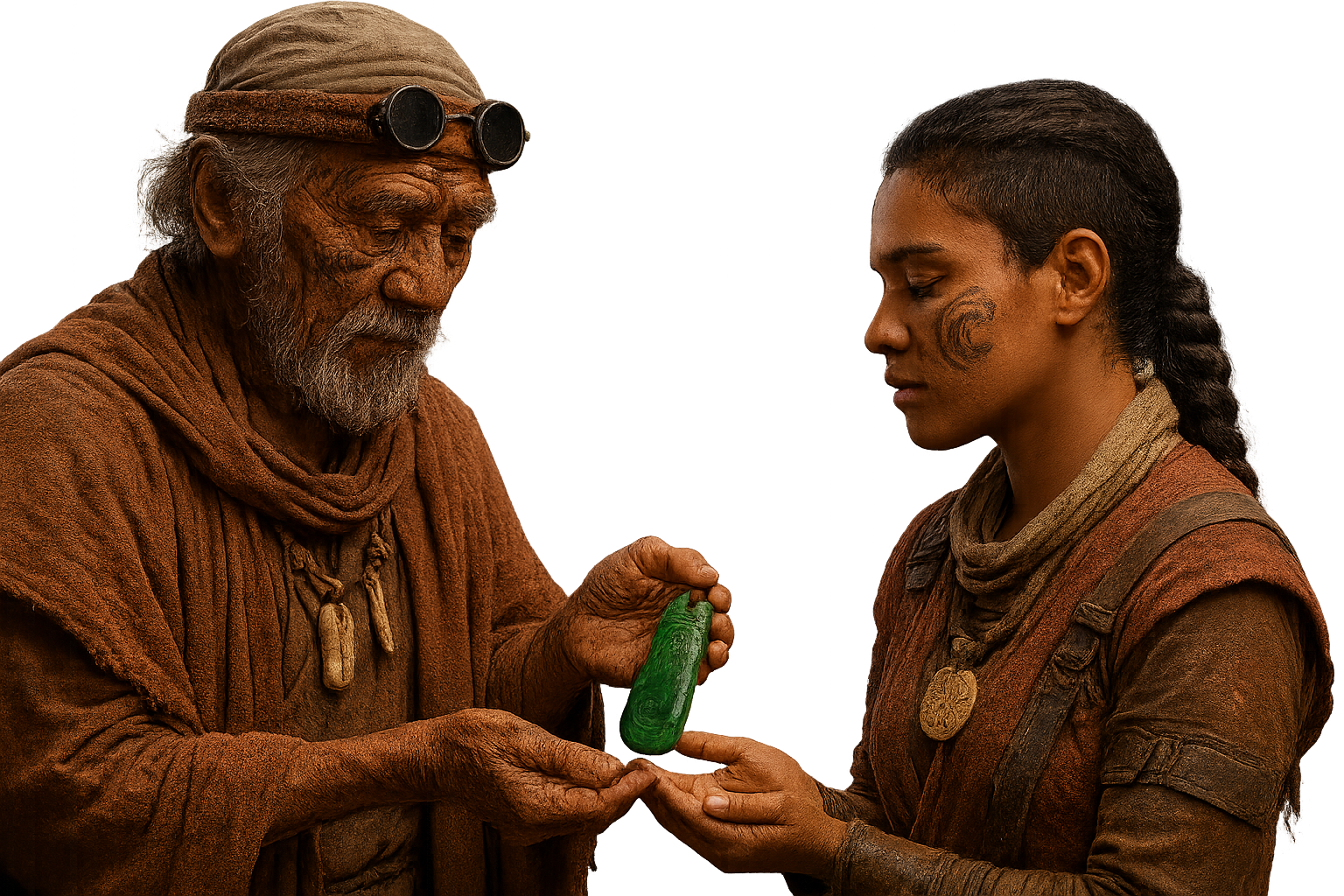
When a birth is anticipated, the Run moves to a known oasis, with unsanctioned entry to that site by manuhiri tapu until the newborn has been named. When someone dies, the Tangi isn’t optional. The Run begins again, back to the Oasis of their birth, reinforcing connection of the people to the land.
Dryrunner Wahkas
Their ancestors were navigators. Ancient seafarers who’s influence spread over vast previously undiscovered territories. When climate change started, and the seas rose these territories sank beneath the waves. As the seas later descended, what turned into a migration of celebration of ancestral lands being reclaimed morphed slowly into ongoing travel as the sea levels continued to fall and temperatures soared, with collapse overtaking the coastlines and resources becoming too scarce to continually sustain a population.
They adapted, becoming Moahtai, and using cultural concepts like tiaki as their guide, converting their homes, convoy ships, and marae into land-going walkers—early Wahka prototypes retrofitted for dust traversal. Over generations, this became permanent logic. Like us, as the years turned to centuries their cultural expressions changed. They retained maritime terms like calling the Dust a sea, and their moving devices both waka and walker (Now Wahka).
These constructs started out recycling old materials, carrying forth pieces of taonga from once stationary settlements. As experiences grew, tikanga incorporated the changes in the world viewed through Dryrunner eyes. The Wahka became more than a home. The Run became more than a community. Together they became the visual record of the voyage of these people.
They became symbols of culture.
Dryrunner Agriculture
Dryrunner Hakū have specialized wahka dedicated to agriculture. These broad, 6 legged behemoths drill into hidden water deposits trapped within the crust. It is then pumped up and filtered, where it serves both to provide water to the Run and grow crops within the heart of the wahka that drew it.
In these mobile oases Dryrunners grow enough to feed their people, and provide hospitality to visitors. The wahka runs have as a result become lifelines to sun baked travelers who have lost their way, and a resource that offers trade to client villages and forts on the frontier.
Support the Build
Like what you see? Help us build Errata—an original world shaped by Indigenous creators, on Indigenous terms. We’re early in development and every bit of support helps bring this vision to life.