
The Bygone Era is the one that feels closest to home. Distance shrank, pipes and rails multiplied, and data smoothed the work until most people forgot what it took to keep things running. Heavy industry, global supply, big civic plants, quiet control rooms on a schedule, artificial intelligence, and the hope of engineering all our problems away. You already know the tools. That is the point.
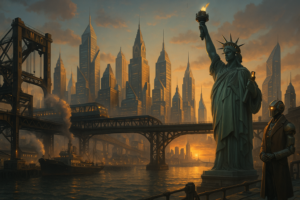 Errata changes the label, but not the logic. The names on the map are the same, so we recognize it as home. But the technology is different so that we can all enjoy the story and take something away. It’s meant to be familiar. Because we’ve all heard the warning. What I’m doing here is turning that warning into a backdrop for an epic story that spans generations.
But in order to do that I needed to break up Earth into the ages that created Errata, turning our home into a list of mistakes.
The Global Environment Warned Them – They Did Not Listen
In today’s world heat is now part of daily life. Record heat-waves have forced school closures, while power companies globally have begun to post warnings because the grid sags due to climate control demands. The Bygone Era sits right there in that feeling about over-industrialization and reflects the modern-day commentary that the fix is more machine, more AI, bigger datacenters, and greater efficiency.
Meanwhile our coasts tell the same story. As long as ships still dock on time, everyone calls it fine, but food patterns are changing. Fisheries are disrupted, and nitrates pollute waters so that nets pull up jellyfish instead of food. Costs of production rise, pushing disposable incomes down and putting more pressure on household wealth. That is the Bygone pattern. Keep the schedule, shift the problem to next year, and hope the storm tracks the forecast. It’s an overconfidence turned into hubris – that the sea will keep carrying the extra heat and the concrete will keep up.
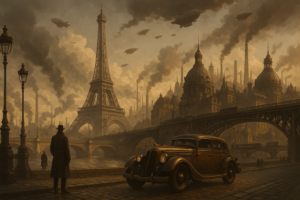 The Bygone Era used technology not to solve the worlds problems, but to delay action. Each new plant, platform, and model squeezed a little more time out of a shrinking buffer, pushing real fixes onto later generations. Costs moved off the balance sheet and onto coasts, farms, and households that could not pass them on. That delay created space for custodians to step in, hold the switches, and sell stability as a service.
When this happened the people welcomed the change.
Modern Economic Problems are Reflected in the Bygone Era
Power settles where custody lives, and in this age custody sits with the offices that control valves, rail slots, cold storage, and the data that decides what gets fixed first. These people are the ultra wealthy, and in the Bygone Era their offices have begun to stop feeling like companies and started acting like kingdoms. Sure, they are still companies in name, but the technology they build is unaffordable to the masses.
The wealth divide has become a divide on who gets to live a comfortable life of leisure, served by Automata specialized in tasks, and who lives day to day, committed to keeping the machinery of wealth in operation. But it’s more than that, too. Technology has enabled life to extend, and death to be evaded, at least in part, by transferring consciousness to genetically created clones. These clones retain their corporate seats, their plush offices, and their lavish lifestyles over generations. Their ideas become the bedrock of society. Their permanence creates an institutional resistance to change which their Autotmata enforce as part of the corporate contract.
That is who becomes the Clone Kings later. There are no crowns or thrones. Just boardrooms run by people who never need to retire and views that never have to adapt. The real play has become a chain of custody that does not age out. And if, just if, an event or series of events were to happen that threatened that chain of custody, these individuals will call it order and take charge, creating wealth driven ration books, corporate-owned depots, and permits endorsed by a government that serves their interests.
Indigenous Culture at the Crossroads of Modern Issues
When I started this project back in the 1990’s I framed it around the question of climate change. Back then we called it global warming, and while we worried about cities like Paris, London, and New York City, when the conversation shifted to indigenous people the reply was almost universal: They’ll have to move. That type of heritage loss is not hypothetical, and clearly its not something tied to the history books, characters like Andrew Jackson, and concepts such as manifest destiny. It’s ongoing.
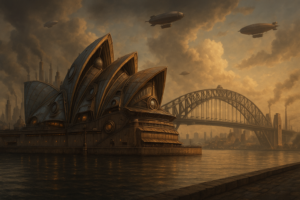 Just as an example, Australia’s Juukan Gorge was blasted in 2020 despite 46,000 years of continuous cultural value. The parliamentary inquiry found systemic failures in company process and law, and the federal response committed to reform that is still working its way through policy. However that did not change the outcome for the people here. The company got what it wanted, and the government promised to look into it. That’s all. Ultimately a “restitution payout” will happen that is a small percentage of what was earned. The land will still be gone, the people still displaced, and the company will have turned a profit doing it. In Errata terms, that is a Bygone habit made visible. When heritage is treated as a routing problem, that breaks trust for generations.
Ihumātao shows how historic dispossession and modern planning collide in New Zealand’s own backyard. Although international optics showcase the Treaty of Waitangi as an example of cultural respect, on the ground Māori have been fighting claims against illegally occupied land since 1840. In this case, after years of occupation and negotiation ended with a Crown buyout in 2020 to halt housing development at a site with deep mana whenua ties. While many people framed this as a planning issue, or even Māori entitlement, this serves to highlight that indigeneity exists as a state under pressure. Even today many Māori exist without basic necessities guaranteed, with water brought into drought areas in trucks and distributed from central Marae during heatwaves. Cities do not face the same pressures.
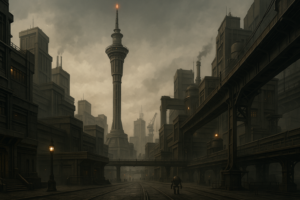 This pressure state continues to increase because governance and enforcement does not change. Profit rules the day, and the needs of industry take priority. This leaves indigenous people feeling sidelined. With more than half of known transition mineral resources sitting on or near Indigenous lands this problem becomes an existential threat to many of these societies. In Errata’s Bygone age we are able to look at this unfiltered. This age, like ours, is the pinnacle of modern civilization. But like ours, it does not come without pressure on outlying communities.
So what’s all this have to do with a video game?
The Bygone Era matters because it shows how a world like ours makes itself brittle. Momentary efficiency geared towards output metrics hides cost, while accountability is deferred to those who will need to deal with the problems of today’s excess. The Timeline of Errata is not a surprise after this; all we’re doing is giving people a space to experience that timeline’s ultimate end.
We keep the Bygone close to Earth so people will believe it. But we change the technology used so people can believe this as a fiction and not leave the room. That mix lets players operate inside the real problems and experience some of the pressures of this conflict for themselves, on their own terms. They get to see how communities endure inside systems that were never designed for them.
In our next article we will talk about The Collapse, and how Aotearoa became an ideal place for continued human habitation as the developed world crumbled into chaos under the weight of its own demands.