
In our last post we discussed the Age of Sovereigns and how corridor control turned survival into a contract. We followed how water and dispatchable energy set the map, how gates set prices, and how cities lived or died by whether their seats could keep power flowing and raiders out. In this post we are going to take it one step further, and talk about what happens when the ledgers can no longer describe the ground they claim to govern.
Once the prices stop matching reality, do the Sovereigns adapt fast enough to save the system.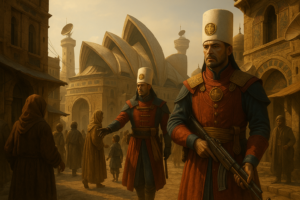
The short answer is: No, they do not. Partly this is because the nature of institutions is to defend their own record as if it were truth. But the other part is simpler. Scarcity keeps tightening. Repairs take more than the corridors can deliver. The city gates still read accounts, yet the pumps behind them are dry. When the ledger says yes and the pipe says no, the story changes.
This slow break is how things tend to fail in the real world too, and it is why long-run ecological and infrastructure debts end not with a single collapse but with a thinning out that looks like normal until it is not.
In Errata we call the time when the contracts outlive the capacity that once backed them the Barren Age. After roughly two millennia of enforced control under the Sovereigns, the reservoirs are silted, the lines have been cannibalized, and the mines that fed the Automata have gone quiet or poisonous. The same faces have been in power long enough that their very existence has become unquestioned. The Sovereigns simply are, and their eternal longevity is proof of their right to rule. Corridors that once ran like arteries become risky, narrow, and intermittent. Genetically engineered beasts, once marketed as necessary adaptations, or tinkered with as experiments in survivability, now roam free across the landscape. Outside that, raiders attack trade arteries, outcasts cling to any thread of survival, and players move between all of these extremes.
The Barren Age is the moment when continuity ceases to be a system and becomes a craft again.
Machines Outlast Their Manuals
Automata did not vanish as resources dwindled. They became enforcers of ancient codes that through the passage of generations, we forgot about. In the Barren Age, you find them in three states. Some are inert hulks whose alloys are worth the risk of cutting. Some cycle a surviving task forever, guarding their ancient vaults and awaiting the next status report because no one told them to stop. But the ones we see are the ones that maintain the divide between rich and poor. They enforce the standards, recite the codes, and perform the labor that ensures the wealthy remain one step ahead of the masses, always.
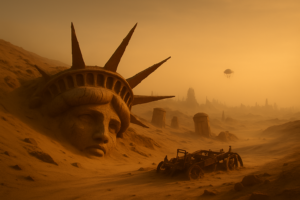 Two thousand years of economic strangulation leave grooves in a culture. Rumors persist of lost vaults in the wilderness. Rich caches of wealth, with ancient technology that can solve the worlds problems. Still pumping water. Some say the Dryrunners know of a thing called an ocean. Not the toxic chemical seas cut into steep desert valleys, green from heavy metals and salts, but full of life. Are these seas out there, somewhere?
In the Barren Age, families carry those stories like they carry water. Some are told as hope. Often they are relayed as warnings. Hope can get you killed.
The Dryrunners Make A Nation Of Motion
Outside the seats, the Dryrunners are not raiders or relics. They are the shape that life takes when corridors fail, and community grows to fill in the gaps. Wahka caravans criss-cross the desert, going from oasis to oasis as if they know the path. Routes change for those in the cities, with oases being swallowed by desert, becoming nothing but rumor. Except to the Dryrunners. They seem to know where to find the water.
These people live by what they can carry and what they can teach, while the entrenched Sovereign powers treat them as problems to be contained. But even they can’t truly live without what the Dryrunners bring. Motion has its advantages, and Dryrunners have an uncanny ability to not just find water, but to uncover technology that the cities can’t live without. They sell this back to the cities through independent trade relationships while the Janissaries extract their tolls and the Sovereigns never act decisively against them, despite public policy clearly stating that their lifestyle is a threat to order.
 The Barren Age treats them as proof that moving wisely is a kind of home.
What This Age Means For Play
For Errata, the Barren Age is not an empty map. It is an evolving set of scenes where every move costs sweat, and areas can be re-explored as the desert sands shift, revealing new opportunities. There are two lifestyles to choose from. Do you live in the cities, and work with extractive forces? Or do you align with consarvation, and drift ever outward? Each player will express their desires here differently. Will you treat machines like old friends who might forget your name, or will you work with them to help manage your settlement?
This world is powered just as much by who you know as it is by what you know.