
In our last post we discussed the Collapse and how climate and economic fluctuations drove the people into a state of emergency. We talked a bit about who responded to that state, and why it was corporations, and not governments, who ultimately found authority in the moment of crisis. In this post we’re going to take it one step further, and talk about what happens next.
 Once the corporations assume power and stabilize society, do they stop?
The short answer is: No, they don’t. Partly this is because the nature of power is to try to preserve itself. But the other part is more to the point. This change didn’t happen in a moment of muscle where enforcement suddenly achieved compliance. It happened over time, with institutions protecting their own interests first, and then expanding out to those that could continue to best serve those interests.
This gradual change in power is how things tend to happen in the real world too, and its why when authoritarian regimes take shape they’re often very hard to undo.
In Errata we call the time when these regimes start to become normal the Age of Sovereigns. In the roughly 2,000-year period after the Collapse, corridor access to water and dispatchable energy became packaged as enforceable contracts, justified through increasing scarcity and ongoing civil unrest that required armed response. Not all of Earth’s cities make it through the Age of Sovereigns. Many vanish, either through inability to maintain supply, or through war. What remains are seats of power that formed where energy and water persisted. Corridors persisted where this access could be maintained and enforced. This was difficult on the continents, where large roaming bands of raiders often challenged established footholds, leaving them short of people and supply after the raiders moved on.
The Chokepoints Set the Prices
Recent chokepoint shocks show how route control sets costs in the real world. When Red Sea attacks drove rerouting and higher war-risk, prices rose while Panama transits whipsawed with drought and then made a partial recovery. But in the Errata version of Earth, the chokepoints become much larger zones controlled by high temperatures, no water, and high toxicity. This changes the dynamic from war being a driver to habitability itself being the issue.
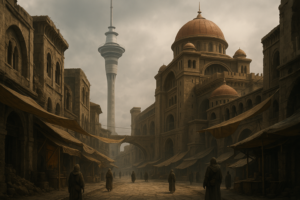
The first response of this was for authorities to turn inward. The corporations closed their cities to outsiders, limiting trade as a way of maintaining price control and monitoring resource bleed. This had a side effect of allowing the corporations to become essentially dictators within their own sphere of influence. These dictatorships over generations became institutionalized monarchies, and the heads of these companies began to be viewed as kings.
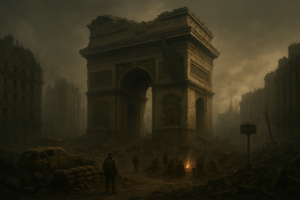 During this time daily life narrowed to what the gates of the city would accept as import and export. Work crews moved when the corridor times were funded and authorized, and standing corporate patrols began to be viewed with their own authority. The kings seized on all of this, using the opportunity to rebrand themselves and their legacies using Earth’s own history books. The control checkpoints became patrolled by Janissaries, acting under the will of a sovereign monarch. Essential supplies such as food, technology, and raw materials became strictly governed, and neighboring cities that did not cooperate found themselves suppressed, their goods seized, and their populations disbursed.
Resource Access Becomes Leverage
Industrialization continued during this period, as companies expanded ventures into new lands once covered by ocean. This extended modern day policies where Pacific governments formalized seabed mineral access, and was viewed simultaneously as a cost reduction and an opportunity to move operations away from more aggressive city-states. As the deep mines became depleted, these newly appearing resources only went up in demand, allowing some city-states to emerge as stable areas that exploited these new supply lines.
But is this realistic? Recently, IEA projections show concentrated refining and supply risk for transition minerals, with copper flagged for structural shortfall. In New Caledonia, their 2024 unrest shows us in real time how minerals plus legitimacy crisis can shut a node down. Our Sovereigns are repeating patterns we see in real life playing out right now. This brings some of the conflict close to home in ways we can feel.
Automata Production Halts, and a Railroad is Built
The Sovereigns and their Janissaries could not keep the status quo, though. Resources dwindled, and with global access being disrupted by thermoclines that made air travel hazardous, warfare that made the continents chaotic, and hot zones that made land travel deadly, the Earth’s trade lifelines ground to a halt. Many trading hubs such as Saudi Arabia, Cairo, Singapore, and the Gulf of Mexico simply became too hot to remain habitable. Others were impacted by constant raiding and warfare that perpetuated starvation until all who were left were Automata. But Automata require maintenance, and the very mines where rare earths that they required were in short supply to begin with, and now were either depleted or had gone dark.
 The Automata maintaining the broken cities started to break down.
Then those cities went dark, too.
Soon only repair facilities remained, like the production facility in Taupō. Powered by rich geothermal energy the lights stayed on in ways that both kept Auckland from leveling it and allowed for a powerful recycling center to operate, stripping necessary materials from broken Automata to rebuild and repair those that remained. But even these facilities needed metal to operate, and Taupō had very little.
So the sovereigns of the remaining southern city-states came to peace long enough to create a last great work of humanity. A railroad that would transport the remaining heavy metals from the rich mines of Tasmania across the exposed Lord Howe Rise and Challenger Plateau to Taupō. In return for their metals, Tasmania would receive freshly repaired Automata to ensure life continued in Sydney, Brisbane, and Melbourne.
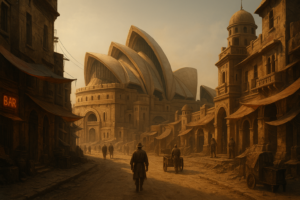
But the peace didn’t last. Australia outside of Tasmania had long since become largely resource depleted and uninhabitable thanks to the excessive heat. Sydney, Brisbane, and Melbourne turned on each other. Melbourne was ultimately demolished, and its sovereign was killed, while Sydney and Brisbane continue to engage in acts of piracy along the rail line, stealing supplies outbound from Tasmania, and inbound from Taupō.
The Gold Cost continued to live up to its name, although now it was less about finding gold, and more about stealing it.
Life Takes a New Shape
Meanwhile the Dryrunners established themselves outside of the cities, offering safety in both numbers and unpredictability. Their land-roaming wahka caravans capable of traveling into the deepest parts of the desert. By stepping away from the trade corridors, they both ensured their own survival, and their continued perception as an outside threat needing to be managed by established authority structures.
In the Age of Sovereigns, public promise has been effectively retired. Access, power, water, transit, and protection have become priced, and anyone unwilling or unable to pay that price has become a de-facto outlaw.
This pattern continues for 2 millennia, and with time memories become stories, and stories become myths. We forget where we’re from, and enter into a new age.
More on the Barren Age in our next article.