
Last week we talked about the Bygone Era and how it contains familiar parallels to todays world. This week we’re going to go a step further, and talk about what happens when society breaks.
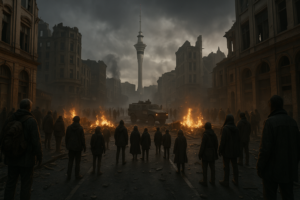 In Errata this has already happened, and it has a name.
In Errata this is called The Collapse.
The Collapse happened in two stages, an initial series of catastrophes that occupied approximately 50 years, and then two centuries of riots, unrest, and social upheaval. There’s no singular event that can be pointed to that caused The Collapse. Instead what we have is a scenario where the system simply stopped working under its own weight. While heatwaves disrupted crops and costs of living rose, Automata were replacing workers, driving stock prices up but paychecks down. People were replacing themselves out of relevance, and the machinery they were using to do it was undermining their chances at survival.
We can see similar events happening in our world today.
Heat Turns Ordinary Plans Into Emergencies
In recent years, heat turned from a seasonal inconvenience into a planner. Electrical grids asked residents to stand down air conditioners and postpone chores to avoid blackouts as demand spiked. Texas issued repeated conservation appeals and emergency alerts as reserve margins thinned during long heat waves. These were not hypotheticals. They were system messages telling you that the buffer is gone.
In Errata terms, the Bygone habits reached their limits, and the Collapse was the result. Energy grids failed to deliver resources to individuals who depended on energy to meet the demands of a failing world. The unchecked hubris of the Bygone Era ultimately left it unable to respond to a crisis of its own creation, because response required energy it was unable to deliver.
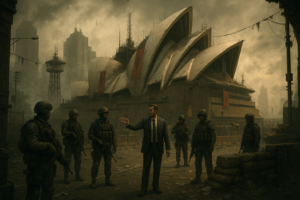
So instead the wealthy districts cordoned themselves off. Military forces paid by corporations and backed by Automata kept districts separate. Outside were rolling blackouts sometimes lasting days. Inside were view screens, advertisements, and air conditioned spaces.
The wealth gap was no longer about money. It was about comfort as temperatures soared.
Classrooms Close Across the Globe
 When temperatures stay high long enough, schools shut and basic care chains fail. In 2024 and 2025, authorities across Asia and Africa closed schools for millions of students during heat waves, with ministries warning of grid stress and health risk. The social cost is not abstract. Lost instruction accumulates, parents leave shifts to supervise children, and public systems struggle to decide whether to keep doors open or prevent heat illness.
In Collapse terms, this is how routines fall into ruin even when buildings still stand. With classrooms emptied lessons were shifted to household delivery on devices only the wealthy could afford.
Global climate records confirm the slope. 2024 edged past 2023 as the warmest year in the instrumental record, with the past decade containing the ten hottest years. The IPCC’s AR6 synthesis outlines the narrowing window for limiting additional warming and the compound risks for water, food systems, and cities.
The Collapse may seem in hindsight like a short event, but it was in reality a slow accumulation of debt until the bill arrived and we were unable to pay it.
Work Without Workers
Bygone promised that smarter systems could maintain continuity indefinitely. In practice, automation removes rungs from the ladder faster than new ones appear. Customer service at a major fintech was shifted to an AI assistant that now performs the work of hundreds of agents, with executives openly describing headcount effects. Labor bodies warn that entry-level tasks are exposed across income groups, with high-income economies facing the largest share of potentially affected roles.
In Errata this shows up as cities that still move under the communications from Liaisons, while Archivists chart outcomes, allocate costs, and position Laborers to complete objectives. All of this is automated. An Automata doesn’t sleep. It always works. Unable to compete, people fell out of the wage chain, creating ghettos, slums, and roving food gangs.
Civil Unrest Unfolds
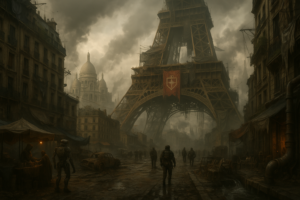 Resource shocks translate into unrest when households cannot smooth the spike. The pattern is well documented. Kazakhstan’s 2022 protests began with a liquefied gas price surge and escalated into nationwide challenge to a system seen as unequal. Sri Lanka’s 2022 crisis grew from fuel and food shortages into mass demonstrations that forced top leadership to resign. Earlier waves linked food price spikes to instability across parts of the Middle East and North Africa, even as scholars debate mechanisms.
Who was impacted by these issues? Not the elite of these countries. Burden fell to those who could not afford to shoulder it, leading to demands for change.
The Collapse in Errata models this same pattern.
While the wealthy of the Bygone Era continued to consume in record amounts, the working class became unemployed, hungry, and desperate. Governments like the People’s Republic of China instituted draconian lockdowns and starvation policies that resulted in mass executions, preserving their own power at the expense of population. Meanwhile, the representative governments of the world quickly failed, unable to shoulder the financial burdens or the political costs of the strain. Corporations replaced nations in enforcement roles as scarcity made each corridor into own microcosm of the world.
Indigenous Continuity Under Pressure
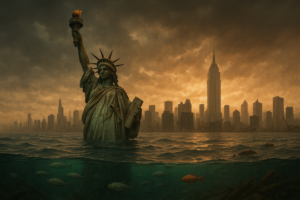 In Aotearoa, old banners rose as people reasserted custodianship, encouraged by the Treaty of Waitangi and enabled by Aotearoa’s geographic isolation and relatively low population. Those who could make it there did so out of a need for refuge as the people of the continents fell upon themselves, blaming each other for shortages.
Meanwhile, Bygone policies pushed costs into communities that could not pass them on. The Collapse exposed that pattern, putting exploitation and blame-shifting in plain sight. In our world, mining and transition minerals overlap with Indigenous territories, creating recurring conflicts where the rewards flow outward and the losses stay local. History shows us that when Indigenous people occupy desired land, the people get moved and the apologies come later.
Except the apologies never came.
Because when the government falls, who is left to apologize?
Corporations took up the burden of control, but did so without the regulation of any authoritative body. When institutions police themselves, accountability is performative.
Indigenous people responded by leaving the cities and relocation camps. Corporations responded with accusations of rebellion, and displays of dominance.
The stage was set for our next entry. A time that would ultimately come to be known as the Age of Sovereigns.