
In last weeks article we went over the trappings of Empire and how these are used to communicate power. This lays the foundation for Errata’s visual world, where power is communicated through what’s seen, and what’s seen directly translates into an evocation of hegemony.
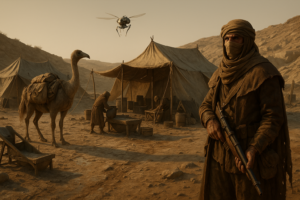 That the Clone Kings and Janissaries are not legitimate inheritors of the symbols they’ve co-opted is integral to Errata’s story, and it’s a bold move. Why? Because we’re trained to fear “appropriation” as only having a negative outcome, and so we avoid it, or try to thinly cloak it in an attempt to dodge the discussion. But in order to tell a story from the perspectives of marginalized peoples appropriation is a topic with consequences, and those consequences must be felt.
So while we’re visually presenting a stunning archetype that mixes the most dramatic aspects of world civilization that in any other context would celebrate human triumphs, we’re also taking the first step down Errata’s real journey. One of discovery, of reclamation, and of choice.
Questioning is Encouraged
During a players first steps in Errata they are introduced to the consequences of profit seeking, and the costs of chasing power. In this journey other options will be hinted at. Players will be introduced conceptually at first to cultures like the Highlanders, Faceless, Outcasts, and Dryrunners through the lens of the modern day dominant human culture of the Plateau. During this process they’ll encounter opposition to these groups, as well as sympathizers. They’ll be introduced to black market groups, police, and trade routes that all depend in some way on technologies and supplies that the cities cannot maintain on their own, and so position themselves to extract those resources, sometime by force, from outsiders. Players will engage in missions where moral choices are ambiguous, and each choice builds relationships that make follow-up choices aligned with previous actions easier to make, while those in opposition may come with consequences that are both immediate and long-term. Things should become clear to the players very quickly that Errata is not a world of absolutes.
What will certainly become clear though is there’s an entire world outside the city walls, and that world presents a whole array of different choices and pathways to thrive.
 Introducing the Dryrunners
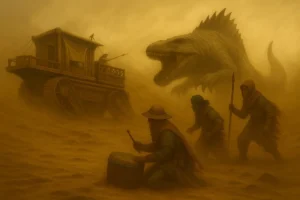
One group that will be often talked about, but seldom seen in town, are the Dryrunners. Often decorated with rich tattoos that adorn their faces and bodies, and wearing green stone talismans, the viewpoints on Dryrunners will vary in the cities depending on who a player talks to.
Janissaries and military will tend to dislike the Dryrunners. If there is respect, it will be given grudgingly and usually based on their ability to put up a fight. Dryrunners are regarded as fierce warriors who much to the Janissaries frustration (or amusement) operate outside the laws of the Clone Kings. Refusing to bend the knee, this puts them in diametric opposition to the Janissaries and Clone Kings, who’s entire claim to legitimacy rests on the willingness of people to subjugate themselves in exchange for material benefit.
City Dwellers will tend to view the Dryrunners with fear. If pressed, many will not have any first-hand knowledge of Dryrunner aggression. Only stories passed down that a friend-of-a-friend knew a person who had a negative experience. They will often support police viewpoints, because doing so marks them as good citizens who are willing to do their part, thus keeping them in the good graces of authorities.
Traders and Drifters often have a different view of them. Traders are known for bringing in exotic supplies from distant locations. Often these supplies include technology that can be used to replenish or repair dwindling civic stocks. While many know that this technology comes from ruins, the known ruins surrounding each city are by this point long emptied of anything useful. Desperate scavengers may find a minor recyclable item, but two millennia of time has passed since The Collapse. This is more than enough time for scavengers. This leaves many ruins of the day to be populated by raiders, outcasts, or beasts. Most people know to avoid them.
This creates an problem though. How do cities that face a shortage continue to supply the goods necessary to keep society functioning?
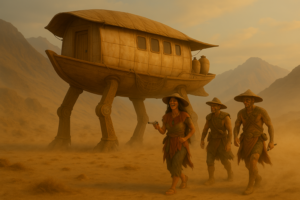
Traders and Drifters know that the Dryrunner caravans carry a good deal of this technology. Dryrunner wakha caravans, called Runs by the city people, and mobile cultural centers that range deep into unknown territories. By cultivating good relationships with the Runs, exotic goods can be regularly brought back to the cities. This is not without risk, though. Relationships with the Dryrunners are sought out by Janissaries eager to prove themselves by bringing Dryrunner society to heel, solidifying supply chains and turning Runs into Janissary owned feeder routes. Those trading with the Dryrunners learn to protect their sources, and the Dryrunners appreciate these relationships as a constant flow of information allows them to keep other Runs informed, and keep everyone safe.
What’s coming up?
In Errata, the symbols are never neutral, and relationships can be about more than just risk and reward. Signaling is always happening, whether that signal is of subjugation, fear, or resistance, its always present, reminding players that their choices shape their experience. Relationships develop as a consequence of choice, and those relationships will shape your journey through Errata’s systems. Errata is not a moral tale, but one where players explore their own morality through an Indigenous lens.
In our next section we will do a deeper dive into how Dryrunner society functions and how it communicates Māori tradition and carries it faithfully forward into a fictionalized environment.