
One of the first questions I’m asked when folks take a look at Errata is: Why do the Clone Kings and Janissaries wear turbans and suits if the game is about Māori culture? Where are the Māori?
This is an important question for two reasons:
First, It shows an expectation of symbolism and performance: that if something is about culture then that culture should be front and center.
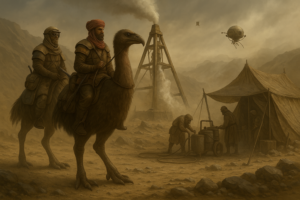 This is actually a good thing. It shows people are curious. They should be, and we’re not going to disappoint, so don’t worry, those cultural motifs and customs are present, and they’re present in abundance. But you likely will only see hints of them when you’re first starting out. This is deliberate.
At Tumeke we’re trying to tell a story of indigenous life through metaphor. Not everything is going to be thrust at you and branded as “indigenous”. We think that’s the wrong approach.
What Errata is in vision is a world where all the players exist in a system of layered bureaucratic and environmental struggle. By necessity the first few steps in Errata don’t introduce people to any protagonist. These steps introduce players to the power structure. The first part of this blog series will be about this power structure, and how the symbols of power help to tell a bigger story.
Second, It highlights an expectation of stereotype. This is neither good nor bad. Stereotypes are a fact of life. Its how they are responded to that creates problems.
Tumeke’s response to stereotypes is to break them. If people expect Māori stories to only take place in the ocean, with grass skirts and catamaran-styled waka, then perhaps what they need is the opposite. So that they can see the people and the values, instead of the familiar tropes they’ve come to expect.
So when I set out to design the Clone Kings, the tyrants of Errata’s post-climate-change world–and the cities they live in, I knew their look had to immediately scream Empire. Think of the feeling you get looking at a Roman colosseum, an Ottoman palace, or even a corporate skyscraper downtown. There’s a common thread: power, wealth, and legitimacy radiate from certain styles and symbols. This isn’t just something we’ve observed. Psychologists and sociologists have been studying how authoritarian regimes and settlers use symbolism to enforce control and create legitimacy.
Our goal was to harness that in our game’s art and world-building.
In Errata, the Clone Kings aren’t just random warlords or stereotypical “bad guys”; they carry themselves like they inherited the mantle of every empire that came before in the same way that real world companies and governments do today. It’s something we hope players will immediately recognize on a visceral level, even if they can’t put it into words.
Why Do the Clone Kings Look Like That?
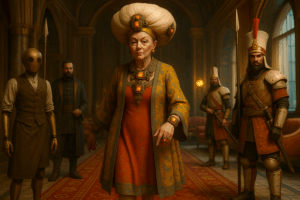
If you’ve seen concept art or screenshots from Errata, you might notice the Clone King city-states have a very Old World Imperial vibe. Tall adobe walls with arched gates, architecture reminiscent of Rome and Istanbul, banners that could be at home in a warrior’s camp, and electronic view screens and neon signs create a very structured, oppressive vibe. Even the gleam of 20th-century corporate skyscrapers poking through the skyline is created to remind people of greatness.
This is all placed against a backdrop not of glamor, but of survivalism. Yes there’s wealth, but there’s also a clear income gap. This is 100% intentional. We designed Clone King cultural visuals by mixing motifs from Ottoman Sultans, Roman Emperors, Spanish colonial governors, and modern corporate moguls.
Why those?
Because all of them, in their own times, mastered the art of looking like they were in charge, and just like Napoleon before them rebuilt Paris to echo Rome, so too did the Clone Kings rebuild the cities of Earth to communicate prestige and continuity, and by doing so visually create an aesthetic of control.
Historical rulers knew that dressing the part was half the battle. In Errata, the Clone Kings copy this strategy. And just like those who came before them, their intent is not benevolent. The idea is that the Clone Kings stole more than just money. They hold more than just power. They rewrote culture itself, shaping it all in images that validated themselves, cynically using knowledge gained during better times to manipulate society as it fell into disrepair.
From a game design perspective, we wanted players to instantly get that “these guys think they’re royalty.” But we also wanted to corrupt that. Yes, they are powerful. But mechanical devices permeate everything, including their attire. Keeping them alive, monitoring them. Showing that they too are controlled by something else. There’s a system in place, and that system only begins with the appearance of power.
Deeper layers are suggested from the outset
Janissaries, Not Police or Knights: The Power of a Name and Image
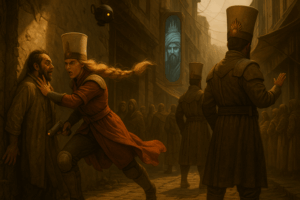
A big question we grappled with: what to call the Clone Kings’ elite enforcers. Early drafts had different names, but none of them really stuck. They were corny, misplaced, and awkward. They often also felt too European-medieval and actually a bit too heroic for what we wanted. I wanted something that evoked both fear and imperial might, and fit the hotter Earth setting of Errata. I landed on “Janissaries.”
Truth be told, Janissaries are just cool. I was fascinated with them as a kid, so when I was reminded of them I bells started going off. They were a clear winner, and they helped to solidify the entire visual presentation of the Plateau societies, which in those early days were suffering from a bit of an identity crisis.
If you’re a history buff, you’ll recognize the Janissaries as the elite infantry of the Ottoman Empire: fiercely loyal, highly disciplined, and decidedly not romantic knights in shining armor. That name immediately brings to mind turbans, scimitars, and the march of a conquering Eastern Empire knocking on Europe’s doorstep. It sets the Janissary Corps in Errata apart from your standard fantasy knights. These guys aren’t chivalrous or independent; they’re hand-picked servants of the state, and their very identity is bound up in serving the Clone Kings.
There’s also the cultural choice of choosing Janissaries. Errata is deliberately not Eurocentric. While we don’t eschew European culture as part of our settings canvas, we think there are enough games out there using European modelling for their cultures. Its easy, there are other cultures in the world, and perhaps there might be a bit of subtle messaging in choosing the culture that was the biggest threat to European sovereignty in recorded history as our dominant archetype.
Visually, our Janissaries take cues from their namesake. They don’t wear medieval plate armor. Instead, picture Ottoman military fashion with a sci-fi twist: lamellar cuirasses (those leather/metal scale vests) combined with dustpunk necessity. Military disciple coupled with corporate greed. The result is an aesthetic that says “this is an imperial army” but not one you’ve seen in a million games before. It complements the Clone Kings’ look and their mentality. When a Janissary squad walks into a settlement, people know that this isn’t a situation you can trust. This is a situation you will need to navigate by knowing how it works.
You’d better have enough money on-hand, in case you need to buy your way out of a problem.
So what’s next?
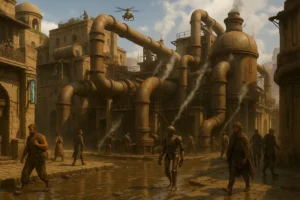
In the cities of the Clone Kings and Janissaries their appropriation of imperial visual motifs isn’t just aesthetic for its own sake. It’s a storytelling device that demonstrates how visuals are used to legitimize their rule and intimidate others. The Clone Kings project authority by dressing in the customers of the old world; the Janissaries enforce control by looking like an unstoppable legion.
Remember, this isn’t just fiction, and Errata is more than just a game. It’s a window into indigenous life and how we see the world and its power structures. It’s a glimpse into what it’s like to navigate a world that is stacked against you.
In our next article I will talk about the Dryrunners, the people of the Plateau, and some other fringe groups.