
When I started designing the identity for Tumeke, I didn’t open Illustrator. I didn’t start with fonts or logos. I started with alot of questions.
I grew up in the United States, not in Aotearoa. I never set foot on a marae until I was 31. That never stopped me from sharing though. I remember being a kid and talking to people about what a Māori was and what we accomplished, usually from stories my dad would tell me. In retrospect, he probably shared culture with me as a way to stay connected to home after moving overseas. But it stuck, and eventually I wanted to go on a cultural trek with my dad. He made sure I grew up aware of heritage, but I learned he wasn’t really that aware of heritage himself.
 He was more aware than me, but he also didn’t really know how to, or even if he should get involved. I suppose its like calling an old friend. You see them on social media posting about their lives, but you wonder: should I call? Will it ruin the memory to pick up the phone?
Since then we’ve both been much more involved. We’ve presented at Rūnanga, gone on marae stays, and involved other family members, encouraging them to start their own journeys. I’ve met business leaders, and I’ve learned about my culture and my family’s shared history.
The last person to speak Te Reo in my family was my grandfather. When he was young he was told it was no longer allowed in the house, because it was viewed negatively and his mother wanted her children to be more successful than she was. This isn’t a commentary on her state of mind. That was a fact of the day, and in many ways remained unchanged until the mid-to-late 20th century.
The net effect though is that my family grew up more missing a piece of their heritage than being experts in it. So when I started this journey of creating identity for Tumeke I had to ask myself what that really meant, and how could I both faithfully represent Māori identity and my own identity as manuhiri to my own culture?
As it turns out, without that grounding, this would’ve been just another studio with a Māori name on a Western skeleton. It’s by owning my own position in my culture that I have been able to create something more, a blend of symbolism that is both true to te ao Māori and still careful enough to not overwrite what I am not aware of.
This became the Taonga of Tumeke Studio, its whakapapa embedded in my own journey.
Carving in Digital Space
In digital space we don’t carve, but we still create, and if we create according to the principles of carving in a way we are still doing it. But we need to be careful. AI does not like carvings, and defaults to flattened, pseudo-swirls and “tribal” motifs that were popular in the early 2000’s as tattoos. I spent alot of time trying to get AI to recognize what was and what was not a proper style. It’s still not perfect to a trained eye, but for a raw concept its miles ahead of where it started.
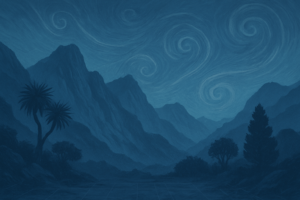
Eventually I came up with the styles that run through the entire page. Styles like the image on the right. I embedded koru logic into the sky as a change-maker and a life-giver, the koru morphing into whorls that show progression and evoke feeling without transplanting the koru itself.
While I could use the koru, I’m very conscious of Māori motifs being used in improper ways through modern society in Aotearoa. Phrases like manaakitanga have become corporate branding to stick on websites, while workers fail to say hello, and reduce people to KPI’s. I don’t want to go down that road.
So I embedded the koru in whorls like in this image. It’s not perfect either, in some ways the whorls are too prominent, and a bit mechanical. Other images do it better. But I felt it was a good way to showcase duality – to have life and change in each image, opposed by a grid on the earth itself, where people tread and leave their mark.
I feel like this visual metaphor and duality captures the essence of the Errata project.
Why This Matters
 I didn’t build these patterns to make the site look Māori. I built them because I needed to understand what it meant to represent something I was still learning to belong to. Capturing these steps in a way helps set the tone for others who are also taking their first steps. Not as experts, but as curious people who want to know more.
Tumeke Studio is built from questions and the decision to stay with those questions rather than skip past them or masquerade as an expert unnecessarily.
This studio carries my name, but it also carries my gaps. It carries the parts of my family story that were lost to silence, to survival choices, to trying to fit in. And it carries the decision to stop treating that as a deficit and start treating it as a place to begin.
Every form I’ve designed here, every embedded pattern, is part of that process. Not as an answer, but as a record of how I’m choosing to move forward. With care. With restraint. And with the understanding that what we build now might one day become someone else’s starting point.
That’s why this matters.
We’re not just building software. We’re not just building games.
We’re creating a space for identity.