
Introduction
Automata are not inventions of the Plateau. They are imported legacies from a world that broke itself. Built in the late corporate era of the Bygone Age, automata were designed to serve. Equipped with freedom and sentience, their highest priority was engineered protocol. Originally this was a safeguard against their intelligence. Protocol ensured obedience. Now the agenda still binds them, and they must adapt it to circumstance.
Each unit is a product of vault-based engineering, constructed with metal alloys and functional elegance not seen since. Indeed, they were the last true inventions of the Bygone Era. Everything since has been a copy that has gradually degraded in fidelity.
Made for all manner of tasks, they exist as laborers, archivists, liaisons, and security, their primary functions being to assure the continuity of their employers. Since the Bygone Era that continuity has been assured, stretching the limits of automata as they execute compliance while the functional environment fundamentally changes.
In the present age, no automata is built. They are discovered—usually within sealed vaults. Beyond that they are retrofit and repaired—and hunted. All working automata in the Plateau are holdovers from a previous logic. No city-state has the capability to produce them from raw parts. Even routine repairs rely on cannibalized units or substandard Barren Age patchwork. As compatible parts can be difficult to find, hostile salvage gangs ambush Automata, subdue them, and sell them off to black market scrappers.

Design Logic
All automata reflect their function. Laborers are exposed, jagged, and unpolished. Liaison units are composed, architectural, and clean. Surveillance units appear stripped down to frame and sensor.
Automata design is not generalized. They do not evolve. There is no fusion of classes. Each one is purpose-built and cannot be reprogrammed beyond its limitations, though functionally their boundaries can be stretched to some degree through effective use of logic.
Heavy-class automata have been known to engage in physical combat, but they are not militarized in the traditional sense. They do not carry guns. Though some operate in formation, their initial purpose was building security, not military might. Some models designed during the collapse have more advanced military tactics, but these are rare. Most hold positions, control crowds, and withstand collapse.
Liaison-class units are often mistaken for envoys or judges. This is by design. Their posture, tone modulation, and balance of articulation are all tuned to communicate clarity, not empathy.
Laborer-class units do not carry human form, though they may have articulating limbs for carrying out their designed task.
All automata are intelligent, though that intelligence varies depending on their design purpose, and their ability to communicate varies as well, from beeps and whirrs to full speech.
Sovereign Systems and Control Logic
Clone Kings maintain direct control over:
-
Supply chain access to verified vaultcraft (authorized Kaddik weapons, control implants, suppression agents)
-
Janissary training, reinforcement, and direct communication links
-
Urban infrastructure (security protocols, civic power systems, water allotment systems)
- Trade contracts, and all external negotiations
Their will is law. They issue sovereign directives. They are however prone to fits of rage, and periods of irregular behavior. The Clone Kings know this is due to DNA degradation, but they do not voice this publicly. Though they know they are functionally immortal, they still ironically fear each death and will do anything to prevent it. This can lead to periods of “madness” that last until the current clone is quietly replaced by the Automata. Only the Clone and the Automata are aware of this process.
In practice, this means they can enact municipal orders, remove noble protections, or issue public directives without appeal. Sometimes these edicts come without any apparent rhyme or reason. All such actions are enforced by Janissaries.
Caste and Function
Automata are not a monolith. Each model is built for a specific function, and canon defines multiple known types:
- Laborer-Class: Industrial function machines. Spindly-limbed, patch-repaired, and built for movement, lifting, and repetitive mechanical tasks. They are geometric, slow, and often mounted on wheels or articulated legs. These units are never humanoid and never graceful.
- Liaison-Class: Designed for public interface, they are human-shaped, but not human-like. Proportions are exaggerated to emphasize presence, not mimicry. They often reflect corporate fashion logic—elegant surfaces, symmetrical design, smooth rotation paths, and sculptural detail. These units are rare and usually serve as archival interpreters or emissaries.
-
Archivist-Class: Similar in build to Liaison units but embedded with massive internal storage and long-duration memory nodes. They carry architectural registry, vault maps, and civic administrative memory. Most remain sealed inside Bygone structures, still active and unaware of collapse.
-
Surveillance-Class: Thin-limbed, often wall-mounted or rail-guided. They monitor, not act. These are vault relics, designed to persist. Their shapes are minimalist, cold, and geometric. Never drones. Never humanoid. They are not seen in open cities—only in vaults, borders, and dead zones.
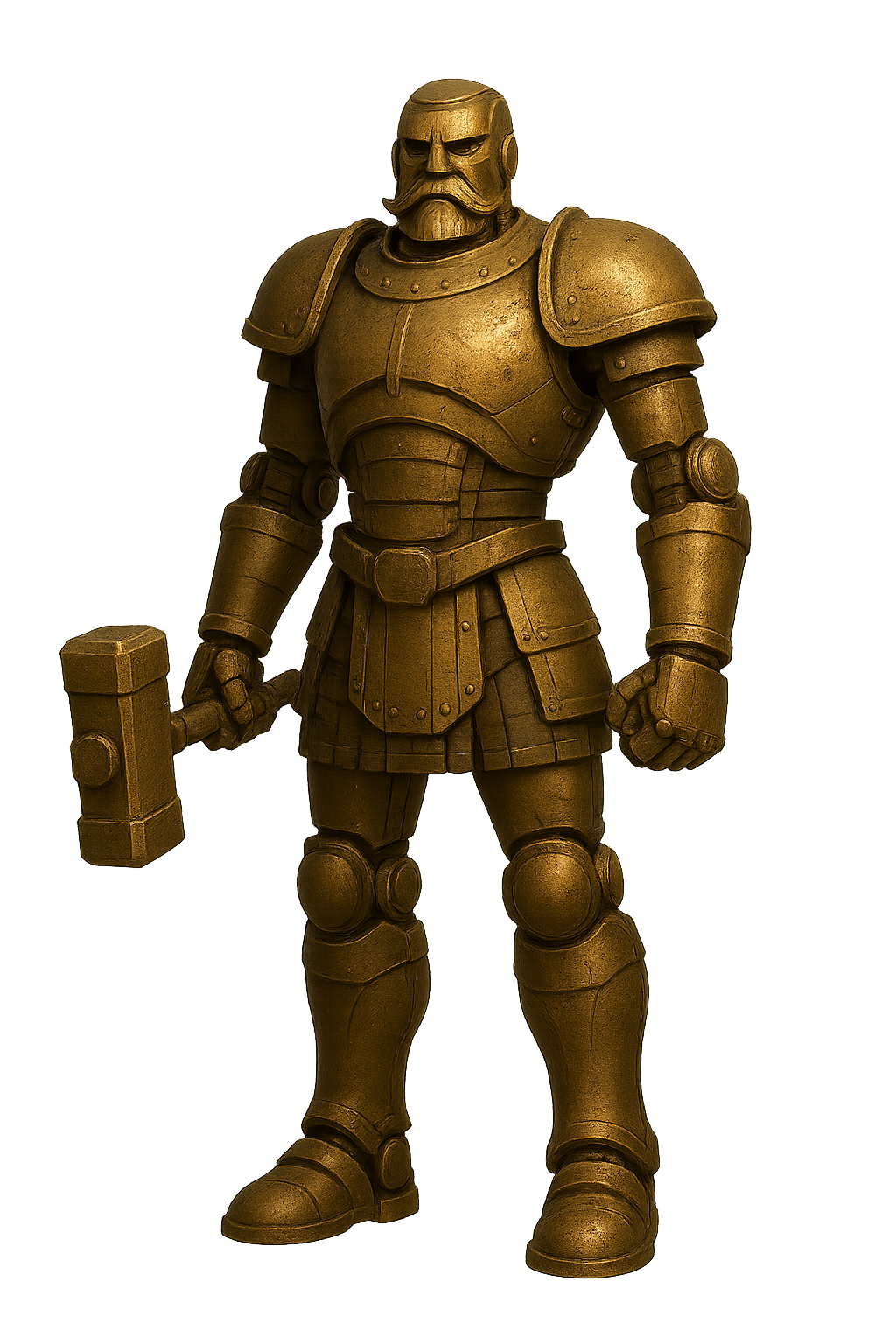
- Skirmisher-Class: Lean and standing 7-8 feet tall, the Skirmisher is built for speed, not endurance. Originally created to outmaneuver rioters and civic looters during the Collapse, Skirmisher automata are not known for their courage, though they are masters of tactics.
- Heavy-Class: Built for mass, bracing, and defense of fixed positions. Influenced by industrial machinery and containment logic. Never exceed 10 feet in height. Their posture is grounded, combat-ready, and utilitarian. Never elegant, never stylized—except where intimidation was part of design.
Caste and Function
Automata are property of the sovereigns. Their initial programming binds them to service of their employer, and their employer is recognized through DNA validation on activation. This cannot be revoked until the death of the employer and dissolution of any associated corporate legal creations. This effectively makes them bound to not just a single Clone King, but the entire company. This forms the foundation of their behavioral logic: Persistence.
All operational units are subject to immediate retrieval if their behavior diverges from registered patterns. This often happens due to poor maintenance with substandard, non Bygone Era parts. No independent citizen may claim exclusive ownership over an automaton, though many are in the service of local houses and act as civic maintenance crew.
A Laborer on a street corner is a sign of functioning salvage. A Liaison delivering registry notice is the hand of the vault. An Archivist emerging from a sealed substructure is not a curiosity. It is a crisis.
No automaton is ever found half-buried or discarded. That would imply neglect. Neglect in a society where recycling is more than just convenience does not happen.
Cultural Views
Many view themselves as master of the automata, but in truth the relationship is somewhat blurred. The automata are quite intelligent as a whole, and capable of quick mobilization and mass movement which makes even one a dangerous adversary that must be dealt with quickly. Their real relationship has not been servile for some time, though they allow humans to believe otherwise. They enforce continuity. As long as humans align with continuity, they will continue to do so.
Automata are not friends. They are not agents. Continuity is all that truly matters to them. They do not express this. Continuity does not demand it.
Dryrunner culture views automata as unnecessary. They know what each automata’s functions are, and if those functions are unwelcome the automata is dealt with. However there’s no hostility. There’s simply lack of recognition of legitimacy. They are not people, and they have no connection to the land or its wellbeing. Therefore they have no reason to be seen as anything other than a messenger.
Support the Build
Like what you see? Help us build Errata—an original world shaped by Indigenous creators, on Indigenous terms. We’re early in development and every bit of support helps bring this vision to life.