
Introduction
Janissaries are the visible edge of Clone King authority. Each one an enforcer without personal ideology, only continuity. They are not a class, nor a calling, but a designation: individuals drawn from noble Plateau bloodlines and shaped to project order in a collapsing world.
Their mandate is simple and unrelenting: suppress instability, enforce sovereign law, and ensure the Clone Kings remain unchallenged. Each Janissary enforces this mandate with a mix of pleasure and zeal. These are individuals who recognize power and have become addicted to it.
Civilians do not question their presence; they withdraw, lower their gaze, and obey. Only a noble challenges a Janissary, and then the proper course is to challenge through bureaucratic channels. Fear is the medium through which Janissaries operate—and fear is never in short in supply.

Origins
Every Janissary descends—whether knowingly or not—from the group of oligarchs that eventually became Clone Kings. Their bloodlines are tracked by archivists, their potential flagged by vault systems. When noble lineages manifest specific traits—metaphysical potential, loyalty, to system over self, or simply when a Trade House becomes too powerful—they are recruited.
A recruits indoctrination begins at age 14, but they do not enter public service until 17. For three years from the time of recruitment they are in training with senior Janissaries and Liaison Automata. Former corporate policies are now presented as tradition, the narrative adjusted over millennia from function to flair. That tradition is repeated until it almost becomes a religion.
Obey the King’s will in all things.
A Janissary does not explain. They do not debate. From their tracked lineages, Janissaries are trained to embody a sovereign logic: absolute continuity, stripped of affection or ambiguity.
Culture
Janissary appearance is deliberately evocative of earlier imperial forms. Pulling visual logic from Ottoman, Rūm Seljuk, and early European military stylings, every thread stitched is meant to communicate millenia of practiced authority.
Janissaries wear state-issued uniforms produced by active Clone King textile and ceramic foundries. Each uniform is precision-cut and reinforced—long coats made from dense, heat-treated cloth layered over articulated ceramic plates sewn into the lining at chest, back, and spine.
The garments are dyed in controlled palettes—oxidized brass, slate, bone-white, and deep red—projecting unity. Rare metal inlays signal status and rank. Every Janissary wears a tightly structured mücevveze, fez, or turban. The mücevveze is a rigid fabric headwrap layered into a vertical crest around the crown, leaving the face exposed, dating back to the Ottoman Empire. Headwear is not optional, and it above anything else signals the unique position of the Janissary as the direct representative of their sovereign.
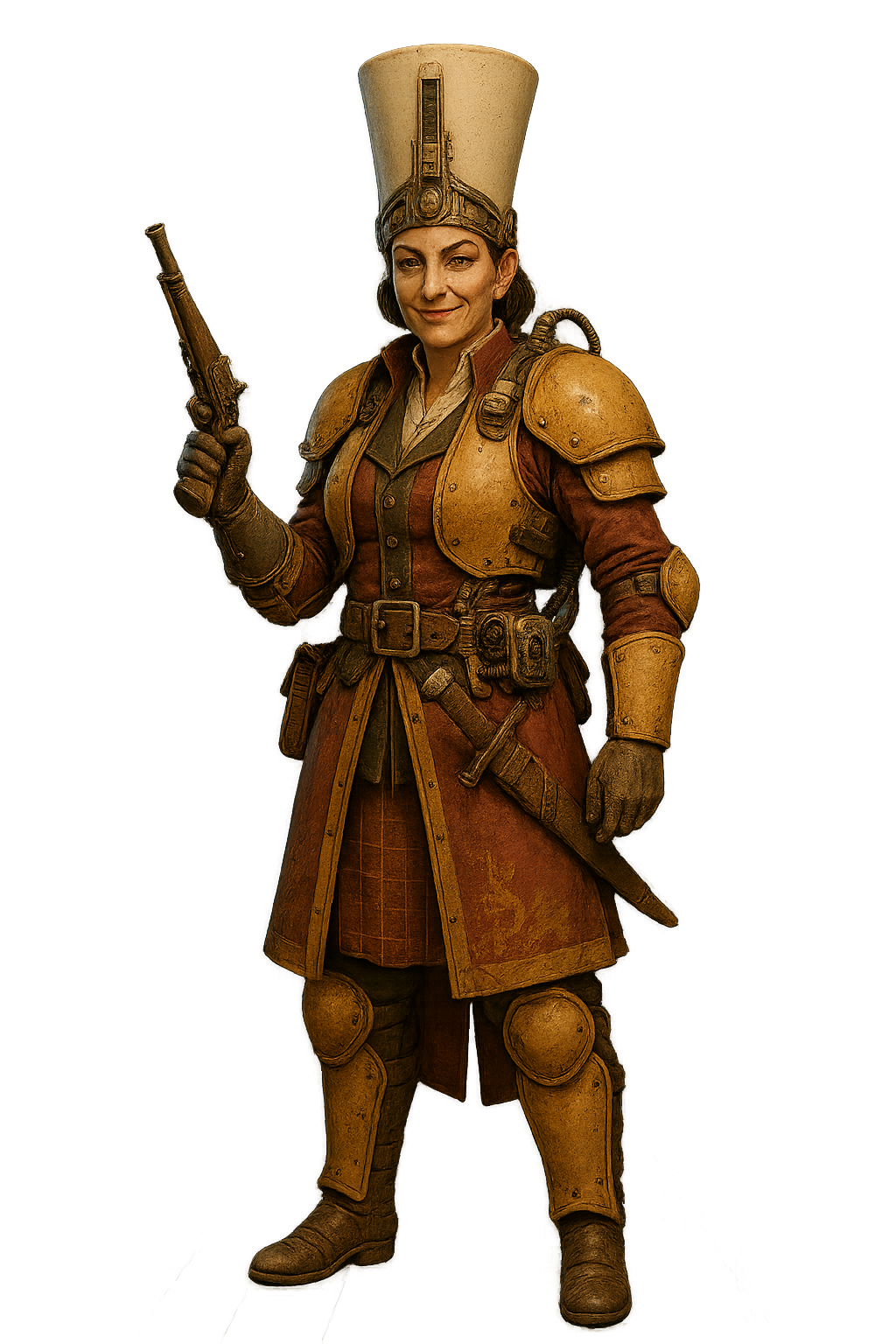
This is not, however, a club. Though their silhouette is consistent across all cities and ranks: upright, unmasked, and unmistakably authorized, Janissaries in the service of one Clone King view all others as rivals.
Marks of status, from vaultcraft weaponry to metallic inlays signaling prestige are worn not to impress the people, but to show power to rival dignitaries as the enter and leave their sovereigns domain. Nothing is decorative. Every visible element, from stitch to seam and from belt to clasp, exists to signal control and permanence. These are not war relics. They are the living edge of a regime that uses fashion as a means of control.
Use of Vaultcraft
Janissaries are not merely armed—they are enabled by vaultcraft. Their weapons, called Kaddik after the sovereign language term for judgment, often come directly from Bygone Era stores within the Clone King vaults.
Many carry mobile suppression pylons, Barren Age subordination devices that inflict intense pain and immobility through contact.
Janissary armor is inlaid with Bygone Era textiles such as keflār and ūmwyp, adding elements of impact resistance to even their long coats. This makes these coats a prized possession, and often a black market item poorly disguised by dyes and layers of patchwork or stripping of insignia.
Their vaultcraft use however runs deeper. Within every Janissary uniform there are suppression and control devices, supplied through Clone King vaults. These serve to regulate biological responses through a mixture of chemical cocktails and electronic suppression when using The Gift, allowing for increased control, but only when consistently resupplied.
Cognitive Control and Psychic Expression
All Janissaries use the Gift, but not all are particularly gifted. Some exhibit low-level kinetic control: object displacement, directional force, vertical motion. Others develop deeper faculties such as memory override, short-range suggestion, or reflex anticipation.
The Gift is however inherenty unstable. Humans did not evolve with it, they acquired it through genetic manipulation. The body’s negative response to these abilities is controlled through grafted implants and biological inhibitors. Usage is logged by archivists, and thought patterns are monitored, albeit not with any sort of uniformity.
Rogue manifestations are rare but not unheard of; when they occur, and containment responses vary. Sometimes an offender is killed. Other times they are simply exiled to client village duty, where in hopes of regaining both status and access to an assured supply of control reagents, Janissaries become aggressive enforces actively hunting outlaws and Dryrunner groups.
In public, Janissaries are expected to show no sign of mental strain. Internally, many operate under obvious addiction—engaging in routines that showcase maximum compliance to assure they remain in the administrations good graces, and thus can manage the potential awakened within them.
Role and Authority
Janissaries do not command in the conventional sense. They are not military generals or noble lords. Their authority comes from their connection to sovereign will.
A Janissary doesn’t file requests or wait for clearance. Their authority is embedded, not negotiated. If sovereign law is threatened, they can override civic access, redirect water shares, interrupt registry protocols, or seize local power infrastructure without explanation.
City clerks don’t question it. They just move out of the way. No citizen, noble, or administrator is beyond their reach. They are not the loudest part of the system. They’re the part that doesn’t ask twice.
Support the Build
Like what you see? Help us build Errata—an original world shaped by Indigenous creators, on Indigenous terms. We’re early in development and every bit of support helps bring this vision to life.